On May 14th, local time in the United States, AI chip company Cerebras officially listed on the Nasdaq (stock code: CBRS), raising a total of 5.55 billion US dollars, setting a new record for the highest IPO of an AI chip company globally. It also ranked among the largest IPOs in the US stock market in 2026 and became the most sought-after hard-tech target in the current computing power boom. On the first day of listing, market sentiment remained high, with the stock price surging from the issue price of 185 US dollars. The intraday increase exceeded 108% and triggered trading suspension. The closing price still rose by 68.2%, fully demonstrating the frenzy of capital on the AI computing power sector.
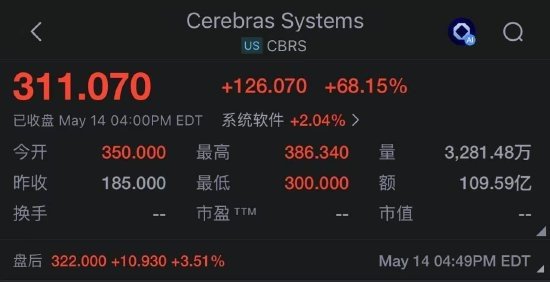
The entire process of this listing was extremely intense, with the offering price experiencing three rounds of significant upward adjustments. It rose from the initial range of $115 - $125 to the final $185. Coupled with an oversubscription of over 20 times by institutional investors, the issuance scale was also expanded. If the underwriters exercised the over-allotment option, the total fundraising could reach up to $6.38 billion, surpassing the semiconductor IPO record previously set by Arm and becoming the benchmark case for US technology company listings in the past three years.
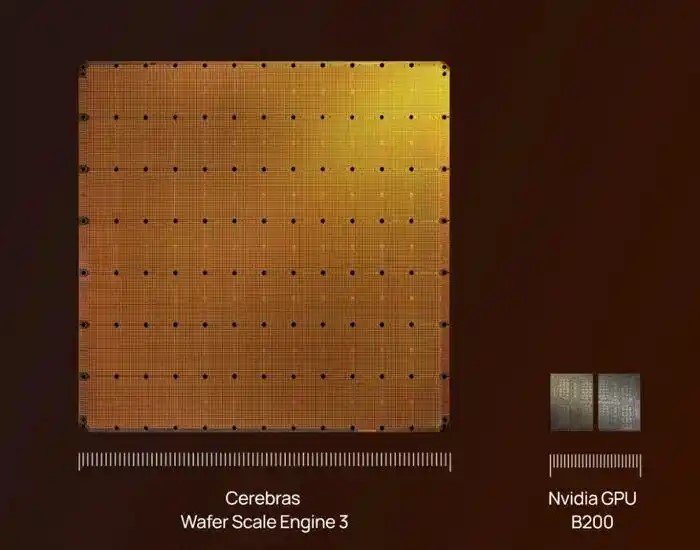
Founded in 2015, Cerebras' core competitiveness stems from its disruptive wafer-level chip (WSE) architecture, which differs from the traditional mode of cutting wafers and assembling multiple small chips used by companies like NVIDIA and AMD. Instead, it directly transforms the entire 300mm wafer into a single colossal computing chip, addressing the transmission delay bottleneck of multi-chip interconnection at the fundamental level. The current main product, WSE-3, adopts TSMC's 5nm process. The chip area exceeds that of NVIDIA's flagship GPU, integrates a vast number of computing cores, and achieves a quantum leap in on-chip memory bandwidth. In the scenario of ultra-large model inference, the computing efficiency can be improved by 10-15 times compared to NVIDIA's H100, precisely meeting the core requirements of low-latency inference for large models, and making it the most differentiated challenger to NVIDIA's GPU.
At the commercial implementation level, Cerebras has successfully transformed from a single regional customer base to a global top-tier enterprise. In 2025, the company's revenue reached 510 million US dollars, an increase of 76% year-on-year. Previously, its revenue was highly dependent on customers such as G42 in the Middle East in the UAE, accounting for as much as 86% at one point. In early 2026, the company reached a long-term computing power order of over 20 billion US dollars with OpenAI. At the same time, it obtained a loan and equity binding from OpenAI, deeply integrating with global leading AI giants. Additionally, it successfully entered the Amazon AWS ecosystem, and its computing power products were implemented in mainstream cloud vendors. The customer structure continued to be optimized. It is worth noting that there is an impact from accounting profits in its balance sheet. After excluding non-cash profits, the company is still in an operating loss state. The contradiction between rapid revenue growth and profit realization remains the focus of market attention.
The successful implementation of this IPO is also the outcome of Cerebras' second attempt at going public. Previously, due to deep cooperation with Middle Eastern enterprises triggering a U.S. national security review, the listing plan was forced to be put on hold. After adjusting the equity structure and optimizing the customer layout, the listing process was successfully completed. From an industry perspective, Cerebras' listing has filled the gap in large-scale capital listings by non-GPU computing power manufacturers, providing a differentiated technical route sample for the global AI chip sector.
However, enterprises still face multiple practical challenges: On one hand, NVIDIA has built a strong barrier through its mature CUDA software ecosystem, while Cerebras still has a considerable gap in terms of ecosystem completeness. On the other hand, the yield control at the wafer level and the high production costs pose challenges to large-scale commercial production, and the economic feasibility of such production needs to be verified. Additionally, the high concentration of customers and potential risks such as geopolitical regulations will test the long-term development capabilities of enterprises.
The enthusiastic pursuit of capital is essentially the market's anticipation of the shortage of AI computing power and the continuous explosive demand for large model computing power. The successful listing of Cerebras not only indicates that the wafer-level computing power technology has gained recognition from the capital market, but also foretells that the AI chip sector has officially entered a new stage of parallel development of GPU and specialized computing power. Whether enterprises can rely on technological barriers to fulfill long-term orders and break through ecological bottlenecks will directly determine whether they can truly shake the industry position of NVIDIA.