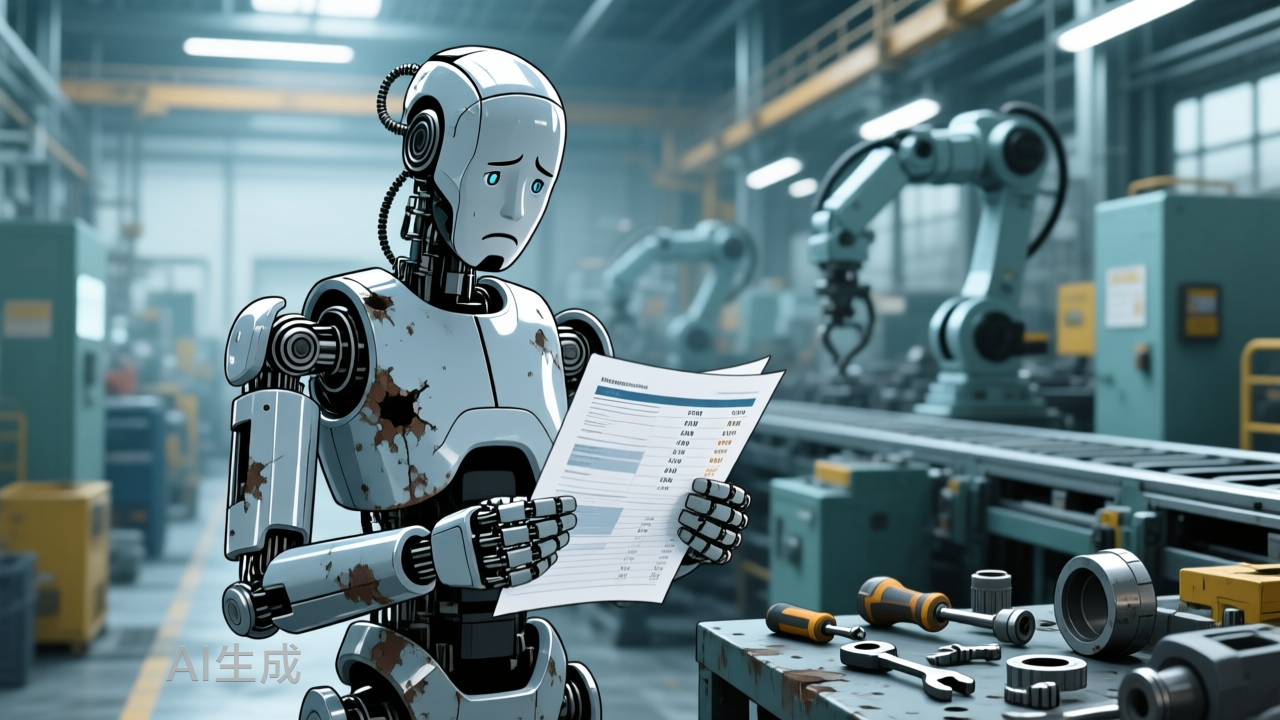
 In 2026, the capital market's enthusiasm for humanoid robots remained high.
Since March, there have been continuous investment and financing news in the embodied intelligence industry. Galaxy General announced the completion of a new round of financing of 2.5 billion yuan, and Songyan Power completed a B-round financing of nearly 1 billion yuan. Data from IT桔子 shows that as of March 20, 2026, there have been 207 financing events in the Chinese robot sector this year, among which 133 are related to humanoid robots, and a total of 115 companies have received funds.
The primary market is continuing to place its bets with real money, and the enthusiasm for this sector remains high. However, on the other side of the ocean, it's a completely different story.
The Silicon Valley star startup K-Scale Labs suddenly disbanded its team and released all its technologies on an open-source basis just before the mass production deadline, with only 400,000 US dollars left in the bank. The pioneer of collaborative robots, Rethink Robotics, went bankrupt for the second time in August 2025 after its first failure in 2018. The social robot manufacturer Aldebaran shut down in February 2025. The children's companion robot Embodied closed down. The pioneer of vacuum cleaners, iRobot, filed for bankruptcy protection in December 2025... These once brilliant names fell one after another before the "dawn".
The contrast between "cold" and "hot" situations forces the market to ask: How far has the robot technology advanced? Against this backdrop, a number of robot enterprises such as U-Bot, Yujiang, Qizhijia, and Yushu Technology have successively released their "annual reports" for the past year. From these financial statements, we might be able to find some answers.
Revenue has generally increased, but the number of profitable companies is very limited.
Looking at the financial reports of various companies, the most obvious sign is that they all have been able to sell their products.
In 2025, U-blox's revenue reached 2.001 billion yuan, increasing by 53.3% year-on-year; iCAG's revenue was 3.171 billion yuan, growing by 31.6% year-on-year; Wanda Robot, which went public on the Hong Kong Stock Exchange at the end of last year, had a revenue of 900 million yuan, increasing by 47.7% year-on-year; "the first collaborative robot company" Yujiang had a revenue of 492 million yuan; Yushu Technology's revenue was 1.708 billion yuan, increasing by a significant 335% year-on-year.
The entire industry is undergoing a collective transition from "samples" to "commodities". Humanoid robots, warehouse robots, household robots, and collaborative robots each have their own growth logic. However, despite the growing consensus, the industry still has structural concerns.
First, although the revenue is increasing, no money has been earned.
According to the financial report data, iRobot suffered a loss of 790 million yuan, which was 370 million yuan less than the previous year, but still had a significant gap from achieving break-even; Yuejiang had a net loss of 84.04 million yuan, a decrease of 113.16 million yuan compared to the previous year; Huaying Robotics suffered a loss of 15.6 million yuan in the first nine months of 2025; Yunji Technology was even worse, with a total revenue of only 550 million yuan from 2022 to 2024, but a loss of 800 million yuan.
Apart from Yushu and iRobotics, the majority of robot listed companies are still stuck in the predicament of "increased revenue but no increase in profit". Even iRobotics, which has achieved profitability, did so for the first time after adjusting for expenses, and it is highly dependent on overseas high-margin markets; Yushu's profitability is based on a special structure where research and education clients account for over 70%.
Secondly, the losses are narrowing, but the "blood loss" has not ceased.
The "three fees" expenditures of various companies remain high. For instance, U-blox's total expenses on sales, management, and research and development in 2025 amounted to 2.561 billion yuan, which was even higher than its revenue; Yujiang's sales and distribution expenses increased by 32.1% year-on-year to 182 million yuan; Woaian's sales expenses rose by 81.3% year-on-year to 312 million yuan.
Although Yushu Technology managed to achieve an average revenue per employee of 355 million yuan with a team of 480 people, this was the result of "extremely simple product lines + extremely deep supply chain + extremely refined team + extremely scattered customers". It does not have universal applicability in the industry. Most enterprises are still in the "relying on investment to drive revenue growth" stage of extensive development, and the turning point of the scale effect has not yet arrived.
Thirdly, the pressure of recovering payments is building up.
Take U-Bot, which was one of the early adopters of embodied intelligence, as an example. The increase in sales of humanoid robots led to an increase in revenue, while the amount of accounts receivable was also high. In 2025, its accounts receivable reached 1.842 billion yuan, a year-on-year increase of 40%, the ratio of accounts receivable to revenue exceeded 92%, and the bad debt provision was as high as 539 million yuan, with a provision ratio of 29%.
For most robot companies, the customer structure determines the quality of cash flow. Those manufacturers whose main clients are governments and large manufacturing enterprises, no matter how impressive their reported revenues are, the tension in cash flow will not disappear. And once the age of accounts receivable deteriorates, the provision for bad debts will negatively affect profits.
These three underlying concerns all point to a core contradiction. The robotics industry is moving from "being able to demonstrate" to "being able to work", but there is a huge gap between "being able to work" and "being able to make money".
From "Cerebellum" to "Brain"
Over the past two years, the technological narrative in the robotics industry has mainly focused on "movement capabilities".
Yushu Technology will conduct the world's first full-scale electric-driven humanoid robot performing a backflip on the spot in 2024. In 2025, the humanoid robot will achieve a running speed of over 5 meters per second, breaking the world record. Ubiquitous Robotics' Walker S series will complete complex operations such as transportation, sorting, and quality inspection in the factory...
These breakthroughs led the outside world to believe that the "physical" issues of robots had been largely resolved. However, the structure of R&D investment in robot reports reveals an undeniable "anxiety".
Yushu Technology raised 4.2 billion yuan through its IPO. Among this amount, 2.022 billion yuan, which is nearly half, was explicitly allocated to the research and development of embodied large models. Ubiquitous Intelligence plans to invest over 500 million yuan in 2025, with 270 million yuan allocated to full-scale embodied intelligent humanoid robots. The company predicts that the research and development budget in 2026 will further increase to 700 million yuan, with a focus on embodied large models, world models, and product iterations.
The R&D expenses of Yujiang increased by nearly 60% year-on-year. Most of the new investments were directed towards embodied intelligence, with an amount of 45.1 million yuan, accounting for 39.3% of the total R&D investment. Although Jizhijia has already made a profit, it still established an embodied intelligence subsidiary in July 2025, laying out a strategic plan for the embodied intelligence field and expanding the technical boundaries...
Obviously, the R&D resources across the entire industry are shifting from the "lower-level" to the "higher-level". Behind this shift lies the fact that the disparities in hardware among various companies are gradually narrowing. "Running fast and jumping high" no longer constitutes a distinct competitive barrier.
In March 2025, Goldman Sachs released a field research report on Yushu Technology, with its core judgment directly pointing to the structural imbalance of the company's technical architecture: "Yushu robots excel not in their brains, but in their gait control technology."
The report states that the perception layer of Yushu adopts a multi-sensor fusion scheme using 3D laser radar, depth cameras and wide-angle cameras. The decision layer's UnifoLM large model integrates reinforcement learning and simulation training; the execution layer implements millisecond-level joint response based on model predictive control. However, these three layers have not yet achieved true end-to-end integration. The semantic understanding level of the perception output is shallow, the generalization ability of the decision layer for open-domain tasks is weak, and the following precision of the execution layer for high-level intentions is limited.
This is not a problem specific to a single company, but rather a common technical issue across the entire industry. The hardware has reached the top level globally, but robots still cannot understand tasks, plan paths, or handle unexpected situations on their own.
In this regard, the shift of the technical stack's focus from the "small brain" to the "big brain" might indicate that the competitive dimension is changing. In the past, it was about supply chain integration capabilities and motion control algorithms; in the future, it will be about the generalization ability from virtual simulation to the real world.
This arms race goes far beyond the hardware level. It not only requires continuous capital investment, but also needs to address the "high-quality physical interaction data", which is a more scarce resource bottleneck than funds.
How far is the "GPT moment" of embodied intelligence?
Data, especially high-quality data, has always been the most crucial constraint variable in the evolution of embodied intelligence.
The reason why large language models have achieved breakthroughs in the past few years is fundamentally due to the existence of a vast amount of publicly accessible text data on the Internet. However, embodied intelligence faces a completely different data predicament.
What it requires are the interaction data from the physical world, such as the visual sequences, force feedback, tactile signals, and corresponding action instructions generated when the robot actually performs tasks. The collection of such data can only be accomplished in a real or highly realistic simulation environment, which is extremely costly and extremely difficult to generalize.
Liu Peichao, the founder of Yujiang, once said: "The valuable data accumulated in the industry last year did not exceed 30,000 hours. There might be several hundred thousand hours of data that are not very valuable and can only be used for pre-training. It is very difficult to achieve generalization and improve the accuracy of (robot operations)."
As the importance of high-quality data continues to grow, "where data comes from" is no longer a technical issue but a strategic one. Facing this common predicament, various enterprises, based on their own strengths, have provided very different answers.
Yushu's strategy is "growing data through hardware". 5,500 humanoid robots have been distributed to laboratories and universities worldwide. Buyers use these platforms to develop their own algorithms and conduct their own research, objectively accumulating diverse scenario data for Yushu.
U-blox's strategy is "trade scenarios for data". The Walker S series directly entered the production lines of BYD, Audi-FAW, and Foxconn, using billions of high-quality data from real industrial scenarios to train the self-developed Thinker large model.
As for the strategy of Overland, it is "building backflow through scale". By manufacturing tens of thousands of robotic arms each year, a data backflow system is established, allowing the operational data from different factories and different workstations to continuously feed back into model iterations.
The speed and cost of obtaining high-quality physical interaction data directly determine the evolution speed of embodied intelligent large models. This means that the competition in the next two to three years may essentially be a battle for data assets. Whoever can first build a large-scale, diverse, and high-quality closed-loop of real interaction data will have the advantage in the evolution of embodied large models.
And for those enterprises with insufficient data acquisition capabilities, even if they have achieved the highest level in the hardware aspect, they may gradually fall behind in the competition at the "brain" level.
In summary, through these financial reports, the growth in revenue indicates the acceleration of commercialization, the narrowing of losses signals the early signs of scale effect, the high level of accounts receivable reveals another aspect of the immature business model, and the collective shift in the structure of R&D investment indicates that the industry has recognized the true bottlenecks.
In the next two to three years, it will be a major test for each company's data strategy and technological approach. Only those enterprises that have completed their layouts on both the "brain" and data ends will be eligible to take their place at the "table" for the next stage.